


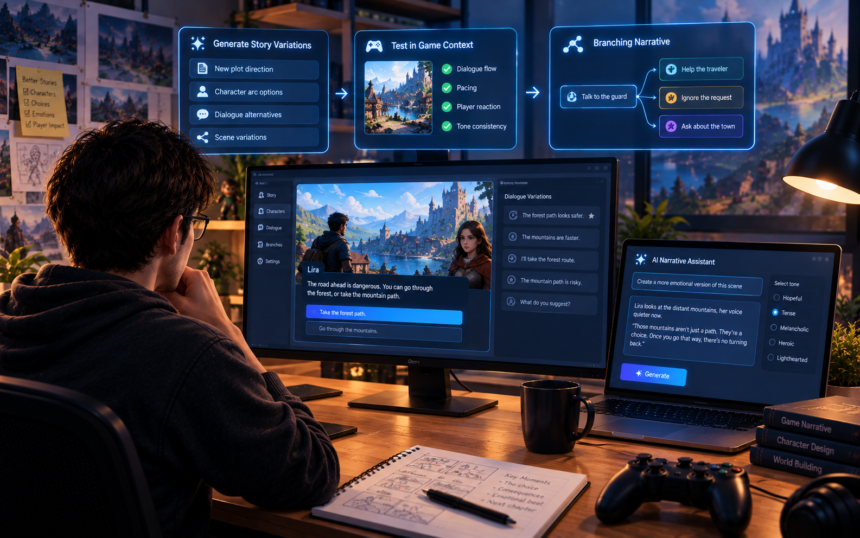
Narrative in games is a different discipline than narrative in books or film, because a game’s story has to survive contact with a player who’s actively making choices, sometimes skipping dialogue, and always interrupting the pacing in ways an author can’t fully predict. Building a narrative that holds up under those conditions has always taken heavy iteration. AI is starting to make that iteration faster, giving creators a quicker way to test whether a story actually works once it’s playable rather than just readable.
Why Game Narrative Is Harder Than It Looks
Stories Compete With Player Agency
A novel or film controls pacing completely. A game hands some of that control to the player, who might rush through a scene, miss a piece of dialogue, or approach events in an order the writer didn’t originally plan for. Good game narrative has to hold together despite that unpredictability, which is a fundamentally different challenge than linear storytelling.
Tone Has to Survive Repetition and Interaction
A story beat that feels powerful the first time can lose its impact if a player has to repeat a section, or if the surrounding gameplay tone doesn’t match the emotional weight the narrative is going for. Keeping tone consistent across both story and mechanics is much harder in an interactive medium than in a passive one.
How AI Helps With the Narrative Development Process
Generating More Story Directions to React To
AI can quickly produce variations on a plot idea, a character arc, or a piece of dialogue, giving a writer more material to react to than starting from a blank page. The value isn’t in accepting any single suggestion outright, it’s in seeing enough options to recognize which direction actually fits the tone the creator is going for.
Testing How Dialogue Actually Lands in Context
Dialogue that reads well on a page doesn’t always play well once it’s delivered inside an actual game, with pacing, player input, and visual context all around it. AI-assisted tools make it faster to drop draft dialogue into a playable build and see how it actually feels in that context, rather than judging it purely as text.
Exploring Branching Narrative Options Quickly
Branching stories are notoriously time-consuming to write and test manually, since every added branch multiplies the amount of content that needs to be checked for consistency. AI can help generate and test branch variations more quickly, making it more realistic for smaller teams to experiment with narrative choice without the effort scaling out of control.
Turning Narrative Ideas Into a Playable Story
A strong narrative concept means little until it’s actually experienced the way a player will experience it, embedded in gameplay rather than isolated in a script document.
More EV News

Why Testing Narrative in Context Matters So Much
The same line of dialogue or story beat can land completely differently depending on the pacing of the scene around it, the player’s emotional state at that point, or how much control they have over the moment. Testing narrative only as written text misses all of this, which is why getting a story into a playable state quickly matters so much for judging whether it actually works.
A Platform Built for Fast Narrative Iteration
Astrocade is a good example of an AI game maker that supports this kind of quick narrative testing, letting creators describe a story beat or piece of dialogue and see it reflected in a playable build without a long production cycle standing between the idea and the experience of it.
Seeing Narrative Tone in a Real Game
Shawarma Master is a good example of a game built around a light, specific premise where tone and gameplay need to feel consistent with each other. Even in games with a playful, low-stakes narrative framing like this, keeping the tone of the story aligned with the tone of the mechanics is what makes the whole experience feel cohesive rather than mismatched.
What Still Requires a Human Storyteller
Deciding What the Story Is Actually About
AI can generate variations and help test how they land, but it can’t decide what a creator actually wants their story to mean or why it matters to them. That core creative intent has to come from the person telling the story.
Maintaining Emotional Truth Across a Project
A narrative can technically stay consistent in plot details while still drifting away from the emotional core that made it compelling in the first place. Recognizing that drift and pulling a story back toward its original intent is a judgment call that depends on a human sense of what the story is supposed to feel like.
Knowing When to Cut Instead of Expand
AI makes it easy to keep generating more branches, more dialogue, more content. Part of a writer’s job is recognizing when a narrative is better served by restraint, cutting material rather than expanding it just because expansion is now cheap to produce.
Common Mistakes When Using AI for Narrative Work
Accepting Generated Dialogue Without Adjusting Voice
AI-generated dialogue often needs adjustment to match a specific character’s established voice and personality. Using suggestions as-is without refining them tends to produce narrative that feels generic rather than distinct.
Letting Branching Complexity Get Ahead of Purpose
Just because branching options are easier to generate doesn’t mean every added branch improves the story. Unnecessary complexity in a narrative structure can dilute the impact of choices that actually matter.
Judging a Story Purely as Text Instead of in Context
Reading a script in isolation misses how pacing, player interaction, and surrounding gameplay will actually shape how a story lands. Narrative decisions need to be tested in the context of real play, not just evaluated on the page.
A Practical Approach to AI-Assisted Narrative Design
A reasonable process looks like this. Start with a clear sense of the story’s tone and what it’s actually trying to make players feel, before generating any specific dialogue or plot content. Use AI to explore variations on scenes, dialogue, or branches, and select the ones that genuinely match that intended tone rather than the first workable option. Test narrative beats inside an actual playable build as early as possible, since how something reads and how it plays are often surprisingly different. Stay willing to cut material that doesn’t serve the story, even when generating more content has become easier than it used to be.
Final Thoughts
AI hasn’t solved the hardest part of game narrative, which is still knowing what story is worth telling and how it should feel to experience. What it has done is make it faster to explore directions, test dialogue in context, and refine a narrative before committing to a final version, which gives creators more room to find the version of their story that actually works once a player is the one experiencing it.